
General Business Strategy
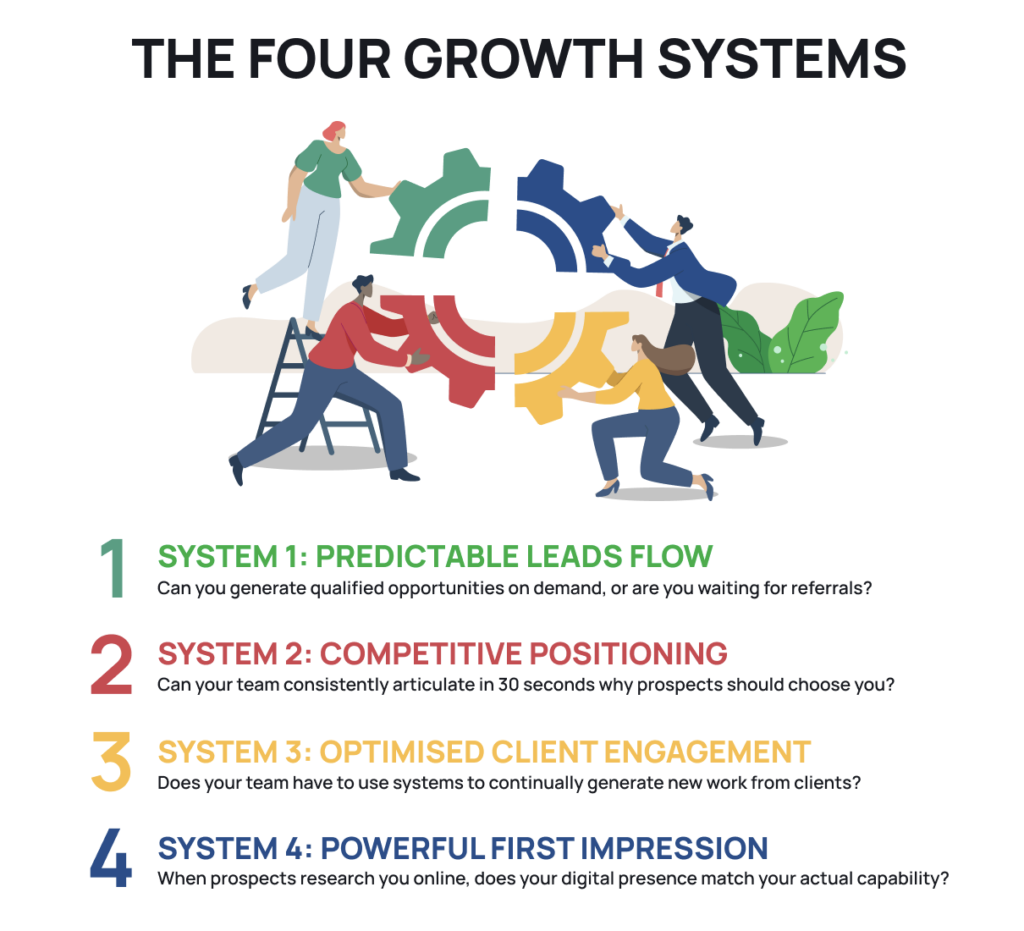
This is the first in a four-part series diving deeper into the growth capability gaps we introduced in our article The Business Growth Capability Gap That Engineering Firms Face. Each article explores one of the four critical systems.
We start here with the one that might cause the most sleepless nights: leads pipeline generation.
Unfortunately, in the course of helping over 30 engineering and technical businesses, what’s become clear is very few even have a pipeline.
What they tend to rely on is a list of people they know, relationships they’ve nurtured over the years, existing clients’ future needs … and the hope that the phone will keep ringing.
In early-stage growth, that’s enough. You build the business on the strength of your reputation, your personal network, and the quality of your work. Referrals come in. You win some contracts. You grow, adding staff and costs.
Then, often between about $4M and $6M in revenue, it stops working. The phone still rings, but not often enough to feed the extra mouths. The odd referral still comes, but they’re inconsistent. Any sales staff you hired to help you fill the gap are largely reactive — waiting for inbound enquiries rather than generating new ones. You feel like you’re the only one who can bring in new work … and you’re struggling to find time.
You’re not growing. You’re just trying to survive on momentum. And it’s bloody stressful.
Here’s the uncomfortable truth about referral-driven growth: it’s not a system. It’s a byproduct.
Referrals happen when someone you’ve worked with thinks of you at the right moment and mentions your name to someone who needs you. That’s beautiful when it happens. But you can’t predict it, you can’t scale it, and you certainly can’t build a $10M or $20M+ business on it.
Every engineering firm that’s ever scaled beyond the growth plateau has done so by building something referrals can’t give you: a proactive, repeatable, systematic approach to generating genuine opportunities.
What does that actually mean?
It means your pipeline doesn’t depend on any single source. It means qualified opportunities arrive consistently, not in feast-and-famine cycles. It means your business development activity is planned and executed deliberately, not left to chance. It means your shoulders no longer have to bear the burden.
When we assess engineering businesses’ lead-generation system, the picture is usually the same. Leads come from referrals, attending the occasional industry event, repeat clients, and maybe calling people you know.
Ask about conversion rates and you’ll get a shrug. Ask about which activities generate the best quality leads and there’s not much more than gut feel to answer the question.
This isn’t a criticism — it’s a pattern. Engineering business owners are typically brilliant at the technical work, genuinely committed to their clients, and deeply proud of what they’ve built. But business development has usually been an afterthought, bolted-on rather than built-in.
The result is a pipeline that looks something like this: a handful of active opportunities, a few conversations on the go, and a lot of fingers crossed that something converts before the current projects wind down.
No system, nor predictability.
Firms that consistently scale past growth plateaus have made a deliberate shift. They treat pipeline generation as a core business function — the same way they treat project delivery, financial management, or compliance.
Getting systematic about sales entails:
None of this requires a marketing department of twenty people. It does require intentionality — and usually, a specific capability that most engineering firms don’t have in-house.
Before you can fix a pipeline problem, you need to name it clearly. Here’s the test: if every current client giving you work and referring you tomorrow, would you have a system capable of replacing that volume of opportunity?
For most engineering businesses at this stage of growth, the honest answer is no. And that leaves them very vulnerable.
That’s not a failure — it’s a gap. And gaps can be closed. But only if you recognise them first.
In the next article in this series, we’ll look at the second critical system: Strategic Value Proposition and Differentiation — because winning more opportunities also depends on being able to clearly articulate why clients should choose you over alternatives.

We’ve built a self- diagnostic tool specifically for engineering firms wanting to close their growth capability gap.
It takes about 7 minutes and evaluates your business against the four growth capability systems. You’ll receive a score showing where you have strong capability infrastructure and where critical system gaps exist. More importantly, you’ll understand to what degree this is actually constraining your growth.
Take the Growth Capability Gap Diagnostic →
InsideOut Group works with engineering and technical businesses developing the growth capability required to scale beyond founder-dependent models without making big investments.
If you’d rather have a discussion about what building these systems would involve for your specific situation, book a 30-minute diagnostic call with Rick Merten