Growth Thinking

There’s a peculiar loneliness to running an engineering business. You’re surrounded by people all day — your team, your clients, your suppliers — and yet the decisions that keep you up at night are ones you face entirely alone.
Should I take on that contract, even though it stretches the team? Is my pricing right, or am I leaving margin on the table? Am I paying my people enough to keep them? Where’s the next new client coming from? Why did that key hire walk out the door six months in? How do I balance delivering projects, managing culture and building business?
These aren’t questions your operations manager can answer. Your accountant can give you numbers, but not wisdom. And your spouse, however patient, has heard enough about the project that went sideways!
This is the gap that Engineering Success was built to fill.
There’s a specific kind of relief that comes from sitting across from someone who’s been through exactly what you’re going through — not a consultant with a framework, not a mentor with a theory, but another engineering business leader who’s lived it. Who’s had the 2am moments you’re having.
When you talk to engineering peers, a few things happen that don’t happen anywhere else.
First, you realise the problems you thought were unique to you are almost universal. The client who keeps expanding scope without wanting to pay for it. The estimating process that somehow always leaves money on the table. The sales pipeline that dries up the moment you’re flat-out with delivery. These aren’t failures specific to your business — they’re the shared experience of running a technical firm with high-value clients.
Second, you get to hear about real-world solutions, not theoretical ones. “Here’s what we tried, here’s what it cost us, here’s what we’d do differently.” That kind of information is worth more than any article or webinar, because it’s been tested against reality in a business that actually resembles yours.
Third, the conversation shifts something in how you see your own situation. What felt like an intractable problem often looks different when you describe it out loud to someone who’s nodding because they’ve been there. Sometimes the act of articulating it is half the solution.

Engineering leaders tend to be sceptical of anything that sounds too much like a motivational talk. Understandably so. But inspiration in this context isn’t about feeling good. It’s about seeing what’s possible. It’s about learning.
When you hear how another owner restructured their sales approach and doubled their win rate, that’s not inspiration — that’s a data point. When someone shares how they navigated a leadership transition and came out the other side with a stronger team, that’s a model you didn’t have before. The best thing about being in a room with people who are slightly ahead of where you are on a particular issue is that you can see the path, not just imagine it.
And the reverse is also true. There’s genuine value in being the most experienced person in the room sometimes — not to show off, but because articulating what you know forces you to understand it better. Teaching is also learning.
Growth stalls when leaders stop getting good information. And the higher up you go in a business, the harder good information is to come by. Your team tells you what they think you want to hear. Your clients are polite about their frustrations. Your competitors certainly aren’t sharing what’s working for them.
The Engineering Success community exists to break that isolation — not with generic business content that applies equally to a florist and a structural engineering firm, but with conversations that are specific to the world you’re actually operating in. B2B technical sales. Skilled workforce challenges. Project-based revenue. Client relationships that span years. Home/work balance. These are the topics that matter to you, and they’re the ones that get airtime here.
Engineering Success currently has two main activities, and both are open to engineering and industrial business leaders across Australia.
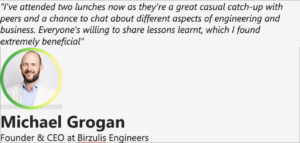
The first is a networking lunch, held in Sydney and Melbourne. These aren’t formal events with a speaker and a lectern. They’re deliberately small, deliberately candid, and designed around the kind of conversation that’s hard to have anywhere else — the one where you actually say what’s going on in your business and someone across the table says “we had the exact same problem last year, here’s what we did.” If you’ve never been in a room like that, it’s worth finding out what you’ve been missing.
The second is the Engineering Success podcast. Every engineering business owner has a story worth telling — the hard early years, the pivot that changed the trajectory, the lesson that cost real money to learn. The podcast exists to get those stories on record, not just for the audience but for the guest. There’s something clarifying about being asked good questions about your own business journey. If you’d like to be a guest, the invitation is open.
Most business networks feel like a room full of people trying to sell to each other. Engineering Success is built differently. It’s a peer group for engineering and industrial business leaders who are working through the same growth challenges and want to focus on solutions.
If you’ve ever wished you had a trusted group of peers to pressure-test a decision with, or just to hear “yes, we went through that too” — this is what that looks like.
Find out more or register your interest at engineeringsuccess.com.au